


While building aickyway, I've used GPT, DALL-E, and Stable Diffusion. What I've learned from using them is that these don't really "create" - they combine probabilistically plausible results, even models that make music. We already live in an era of creating alongside AI.
So one question naturally arises:
How exactly do these AIs write text, draw pictures, and create music?
Today, let's break down how representative generative AIs like GPT, DALL·E, and Stable Diffusion work, as simply as possible without complex formulas.
Let's Start with Terminology 🧠
What is 'Generative AI'?
Generative AI is ✔ Not an AI that picks from existing answers ✔ But an AI that creates entirely new outputs.
It generates content that looks human-made, including text, images, music, and video.
How Generative AI Learns
- Reads massive amounts of data
- Finds patterns and rules within it
- Predicts the next word, pixel, or sound
Here's a simple analogy:
It's like playing every song in the world for it, then saying "Make me a new song in this style."
1. GPT – The Maestro of Text
GPT is the core engine behind most AI chatbots and writing tools we use.
What GPT Does is Simple
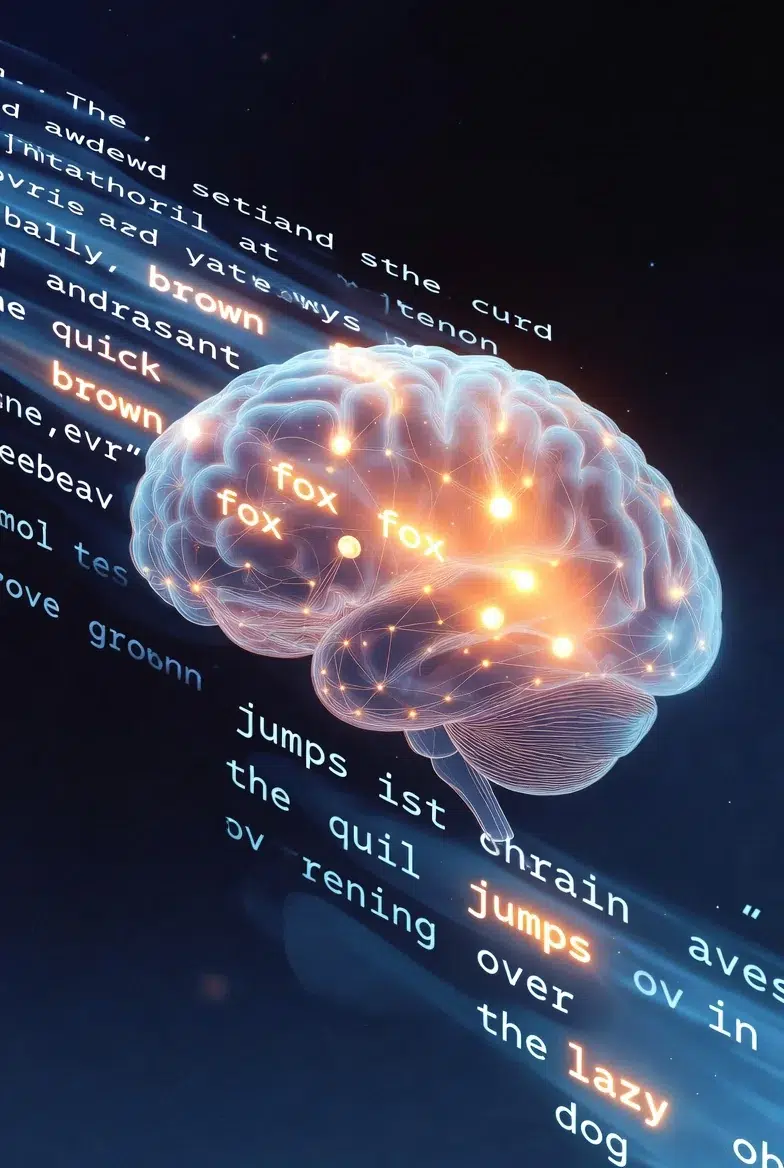
It keeps guessing "What's the next word?"
But the difference is ✔ It calculates this with hundreds of billions to trillions of criteria (parameters) ✔ At super high speed.
GPT Key Specs at a Glance
- GPT-3: 175 billion parameters
- GPT-4: About 1 trillion parameters
- Training data: Over 45TB of books, websites, articles, etc.
Here's the important point👇 GPT doesn't memorize sentences. Instead, it understands context and predicts the next word.
That's why it can write essays, code, and poetry.
2. DALL·E – The AI That Turns Text into Images
DALL·E is a generative AI that converts text to images.
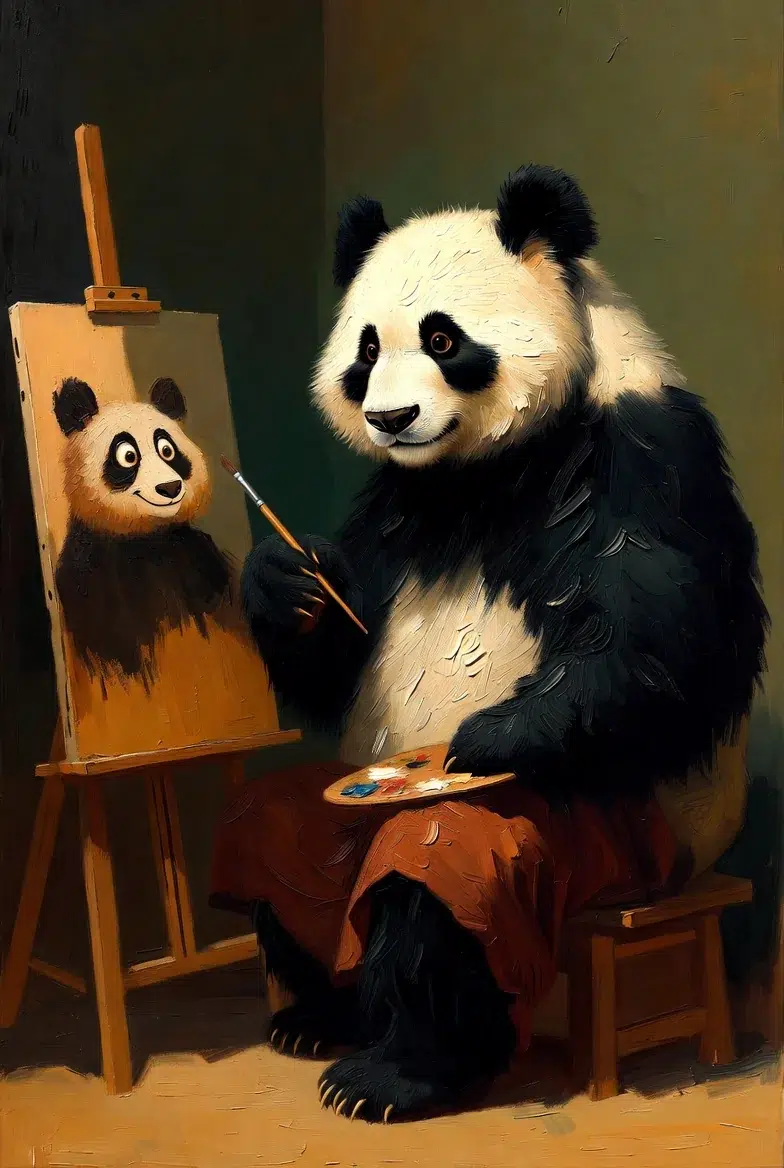
It can turn sentences like "A panda painting a self-portrait in Renaissance style" into actual images.
How DALL·E Works
- Learns the relationship between text and images together
- When it sees a sentence → It infers "If they said this, it should look like this"
- Doesn't copy existing images Generates completely new pictures
DALL·E Key Stats
- Parameter count: About 12 billion
- Training images: Hundreds of millions of captioned images
- Creativity rating: Over 80% by human evaluation standards
3. Stable Diffusion – The Open Source Image Wizard
Stable Diffusion is famous as an open-source image generation AI.
Anyone can customize it, and it's fast and flexible.
Stable Diffusion's Core Principle
It starts like this👇
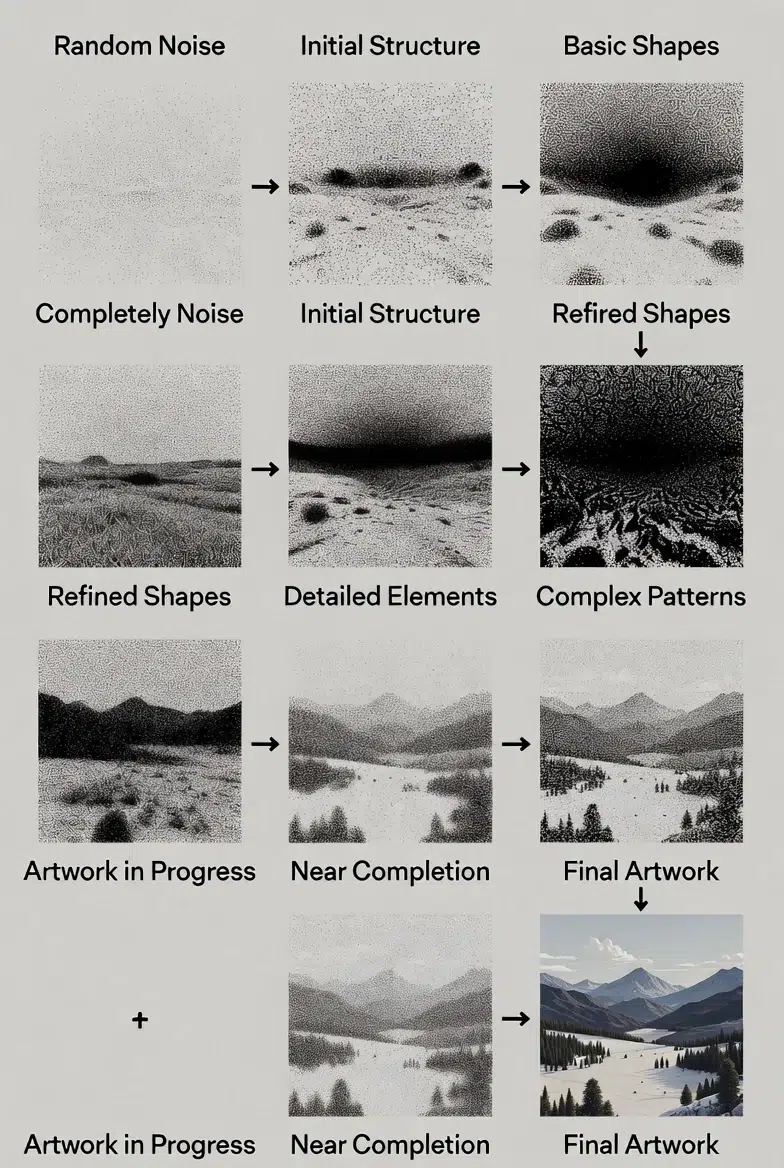
- Screen full of random noise
Then👇
- Gradually cleans up the noise
- Progressively restores form and detail
- Finally completes one image
This process is called Diffusion.
Key Specs
- Parameter count: About 890 million
- Training data: LAION-5B (2.3 billion images)
- Features: High-resolution image generation, high flexibility
4️⃣ Why Are Numbers So Important?
In AI discussions, certain things always come up:
Parameter count, data size, performance metrics
Why are these important?
- Parameter count → AI's 'comprehension' and delicacy
- Data scale → Ability to learn various styles and rare concepts
- Performance tests → Passing exams, commercial viability
That's why today's AI outputs feel like they were made by humans.
Wrapping Up
Generative AI is not magic. It's a combination of mathematics, data, and human-designed structures.
But what that combination has created is ✔ Changing how we create ✔ The definition of art ✔ The future of communication
Next time you see AI-generated text or images, remember this:
Behind it are billions of calculations and attempts to understand patterns.


