


A few days ago, I was chatting on KakaoTalk with someone pretty active in the AI image community, and mid-conversation I got curious and asked: "Do you have any favorite AI artists? If there are any AI-generated works that stuck with you, let me know." After a long pause, the answer was "Hmm... rather than specific works, there are people who are good at prompt techniques..."
That gave me a strange feeling. This person probably spends 3-4 hours a day on AI image generation, yet they couldn't name a single AI-generated work that had moved them. Around the same time, I read a piece by Brennan Kenneth Brown that hit exactly this point. So I wanted to organize my thoughts on this.
Having No Role Models Is a Serious Problem
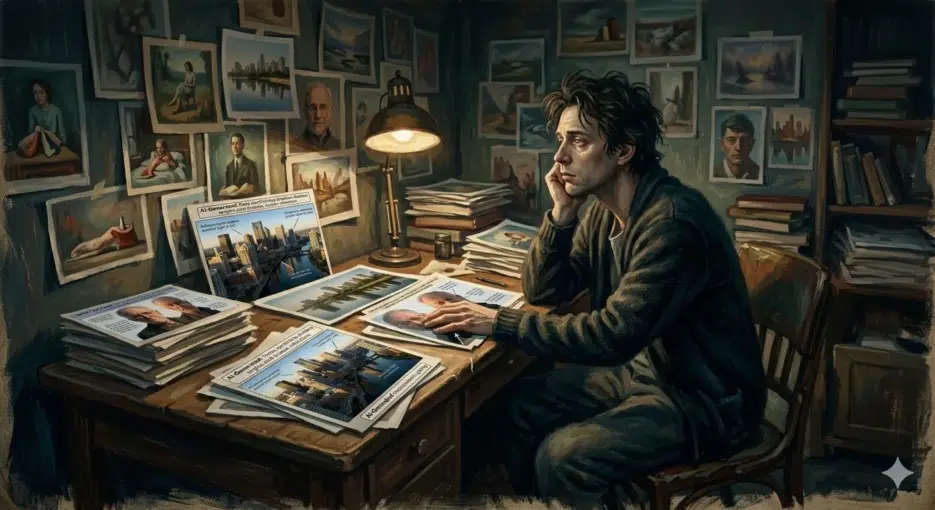
Anyone who takes creative work seriously can rattle off a list of artists and works that influenced them. Ask a musician and you'll get everything from Led Zeppelin to Radiohead. Ask a painter and names from Munch to Basquiat come pouring out. The original author writes poetry and listed over 20 poets who influenced him — Walt Whitman, T.S. Eliot, Emily Dickinson, Allen Ginsberg, Leonard Cohen... and said that was just the beginning.
But when you ask the same question to people who primarily make AI art? You only get technical talk. What model they use, how they structure prompts, what goes into negative prompts. Why they switched from Stable Diffusion to Midjourney. LoRA training tips. That kind of thing. But "which AI art piece moved you" never comes up.
Is this just because the field is still young? I see it differently.
Art Was Originally a Conversation
I'm going to get into some heavy stuff here, but the key point is this: art has always been like a conversation that spans generations. In art history, there's a concept called "artistic lineage" — the historical and conceptual connections between artists across generations. Inheriting, reinterpreting, and sometimes challenging the traditions of previous generations to create a continuity of ideas and techniques.
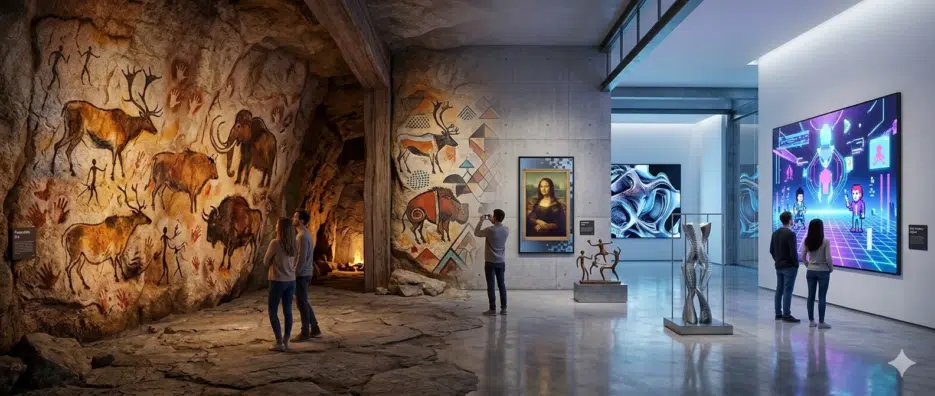
From cave paintings 28,000 years ago to today, humans have been carrying on this conversation without pause. An artwork is the meeting point between the creator's intention and the viewer's response, and that meeting itself contributes to the cultural dialogue.
But AI art can't participate in this conversation. Because it isn't consumed. Creating is too easy, but nobody goes back to study and preserve what's been created. Most AI images are seen once by their creator and that's it. Posted in a Discord channel, a few likes, and then it vanishes. Has any AI-generated work ever been deeply studied or preserved? I honestly don't know.
Prompt Engineering Is Not an Art Movement
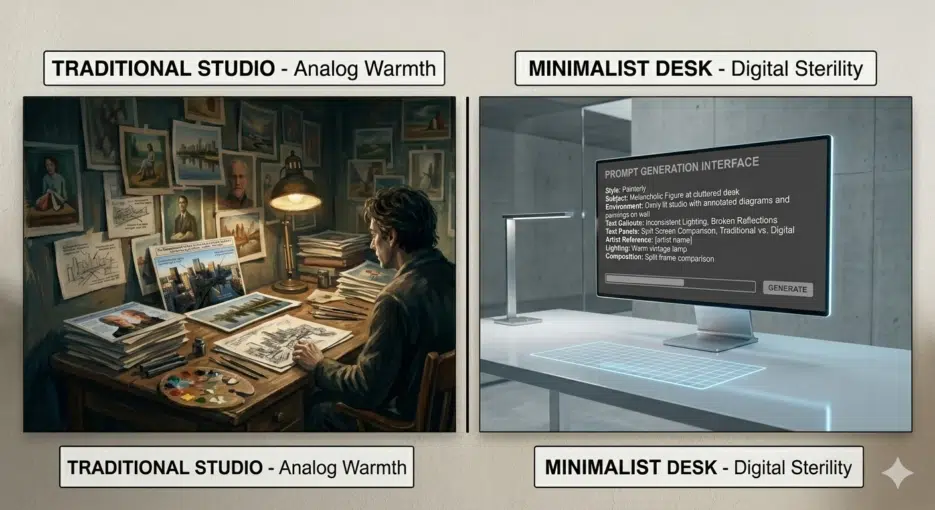
The AI image community does have its own discourse. Technical discussions about prompt structure, comma placement, weight syntax, style keyword combinations are active. But this is fundamentally different from art movements or schools of thought.
The Impressionist painters sharing a common philosophy about light and color, and prompt engineers sharing "masterpiece, best quality, 8k, ultra detailed" are not activities on the same level.
And honestly, there's an uncomfortable part here — prompts directly reference human artists by name. "In the style of Greg Rutkowski," "Artgerm style" — things like that. Instead of building something new on top of existing artistic traditions, it's just taking what's already been built. Concept artist Karla Ortiz pointed this out head-on. AI models can only generate based on real artists' works and intellectual property included in their training data. Ortiz filed copyright lawsuits against Midjourney, Stability AI, and others, and even testified before the U.S. Senate Subcommittee on Intellectual Property in 2023.
The Brain Responds to What Humans Made
There's an interesting study. In an experiment by Semir Zeki, a professor of neuroaesthetics at UCL, brain scans were taken while people viewed 30 paintings by famous artists. When viewing works they found beautiful, blood flow to specific brain regions (pleasure-related areas) increased by up to 10%. Apparently, this is comparable to looking at someone you love.
I haven't found any follow-up studies applying this to AI images, but there are studies showing that when people learn a work's origin is artificial, perceptions of craftsmanship, emotional value, and aesthetic appreciation consistently decline. The moment the brain recognizes "this wasn't made by a person," the response changes.
Honestly, I do have moments where I see an AI image and think "Oh, that's pretty." But it's never lasted more than 5 seconds. I've stood in front of a human artist's work for over 20 minutes, but I can't remember ever looking at an AI image for more than 20 seconds. Whether that's just me or universal, I'm not sure.
Model Collapse: The Future Might Not Exist Either
The problem isn't just the present — the future looks somewhat bleak too.
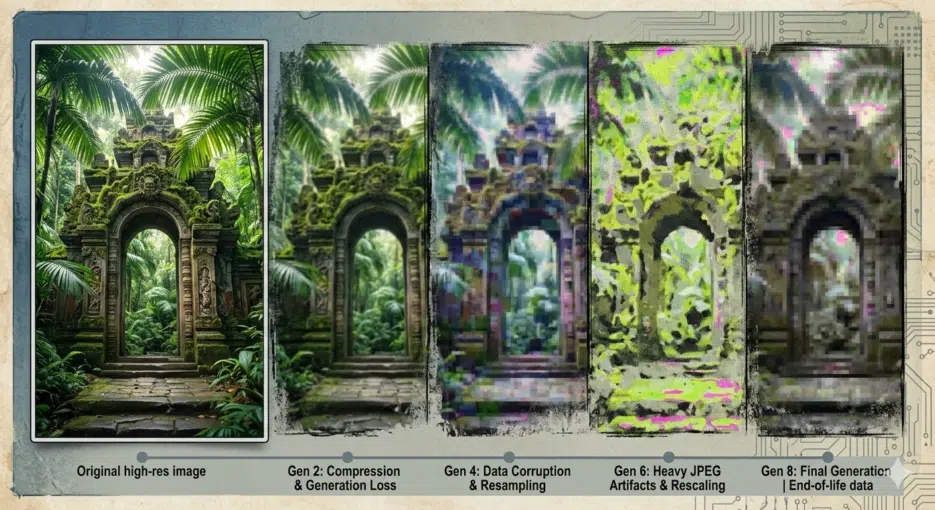
There's a phenomenon called "model collapse" — when AI is trained on data generated by AI, quality degrades dramatically with each generation. A 2024 study published in Nature by Shumailov et al. mathematically proved this: repeated training on synthetic data causes the tail of the original data distribution — the rare, diverse patterns — to disappear, leaving only the average and predictable.
AI-generated content is increasingly flooding the internet. If this gets scraped back as training data, you end up with an ouroboros of AI learning from AI. Like photocopying a photocopy of a photocopy — it just keeps getting blurrier.
Of course, this is the worst-case scenario. There are counterarguments that collapse can be avoided if human-made data continues to accumulate alongside it. Quentin Bertrand from Inria's research team showed experimentally that models train stably when the proportion of real data stays above a certain threshold. So it's hard to say "model collapse means the end of AI." But what's certain is that the importance of human-made data is only growing.
The Lake of Narcissus
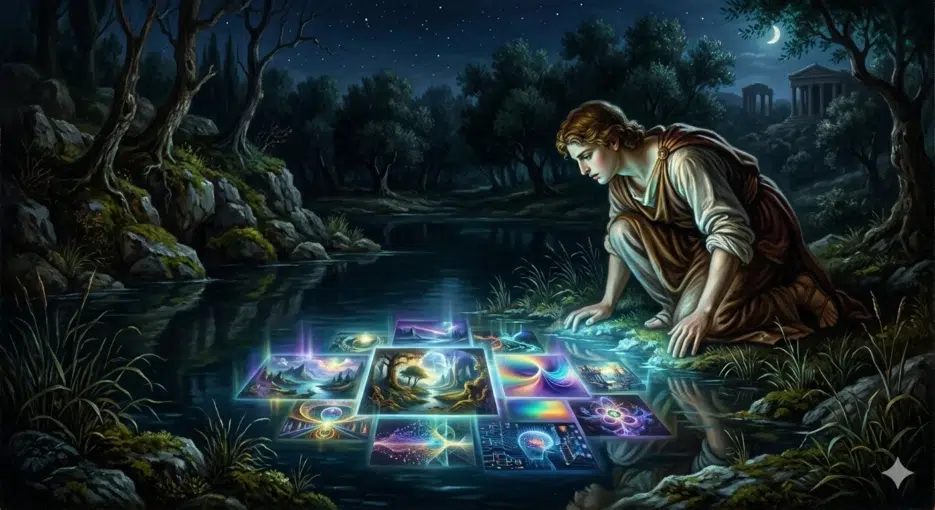
The most striking metaphor from the original article was Narcissus. The figure from Greek mythology who fell in love with his own reflection in the water and drowned.
This is exactly the pattern we see in AI art. Creating your own work, consuming it yourself, making more, consuming it again — a mirror loop. The process of immersing yourself in other people's work, being influenced by it, and digesting it to make it your own is missing. There's no listening before speaking.
And honestly, it's also the temptation to skip the painful time of being bad at something in the beginning. Those desperate first few years of learning to draw, the frustration when what you drew looks nothing like the image in your head. AI lets you skip all of that. But what gets lost in the process is the unique perspective and interpretation that comes from embodying a skill.
Oh, but I want to clarify one thing here — I'm not denying AI image generation itself. I've written quite a few AI image tool reviews on this blog. I use Midjourney and tinker with ComfyUI. I think the value as a tool is definitely there. The problem is the attitude of calling it "my art" while not looking at other people's art at all.
If someone uses AI as a supplementary tool while actively consuming and being influenced by human artists' work, that's a different story. The problem is production without consumption, speaking without listening. There's no way that's sustainable creation.
So What Now?
Writing this, I felt a bit called out myself. I spend quite a bit of time on AI image generation, and when I thought about when I last seriously appreciated a human artist's work... well. It made me reflect.


