


Experience of Ruining Quality by Trying to Save Time with Fewer Steps
Useful Terms to Know First
| Term | Description |
|---|---|
| Chiaroscuro | Light-dark contrast technique. Caravaggio was the master. Expresses emotion through dramatic contrast of light and shadow. |
| Sfumato | Technique of softly blurring edges. Da Vinci's Mona Lisa is the prime example. |
| Glazing | Oil painting technique of layering transparent paint to create depth. |
| Saturation | Vividness of color. Higher saturation approaches pure color, lower saturation becomes grayish. |
| Tone | Overall feel of color including brightness and saturation. |
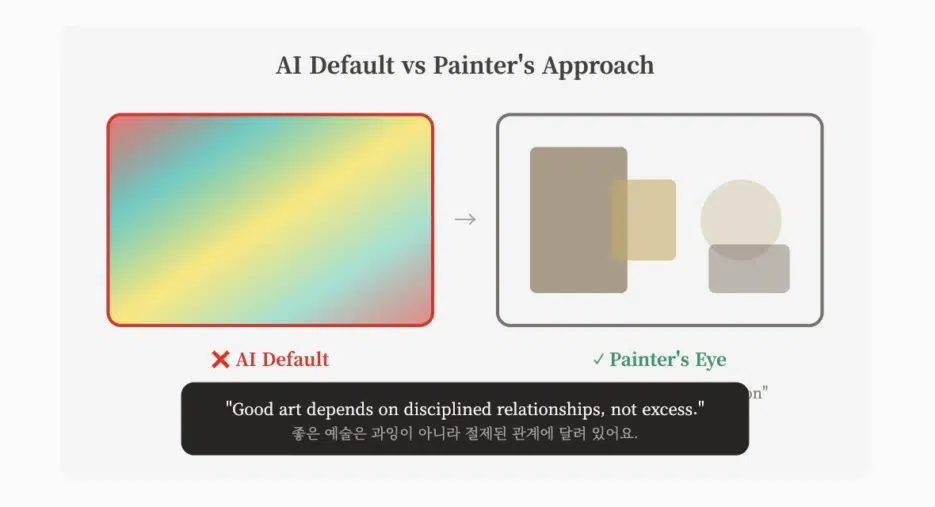
In the rush to quickly produce visually stunning AI images, much of what painters have refined over centuries is being lost — hierarchy, rhythm, texture, and restraint.
Machine models tend to interpret "vivid," "beautiful," and "detailed" as "maximum saturation and sharpness everywhere." The results are often dazzling but hollow.
Painters, on the other hand, build worlds through relationships: Between color and color, edge and edge, stillness and movement.
To breathe artistic sensibility into AI-generated images, you shouldn't think like a designer. You need to think like a painter — working in layers, refining intentions, and orchestrating the dialogue between form and emotion.
🎨 Controlling Color Hierarchy
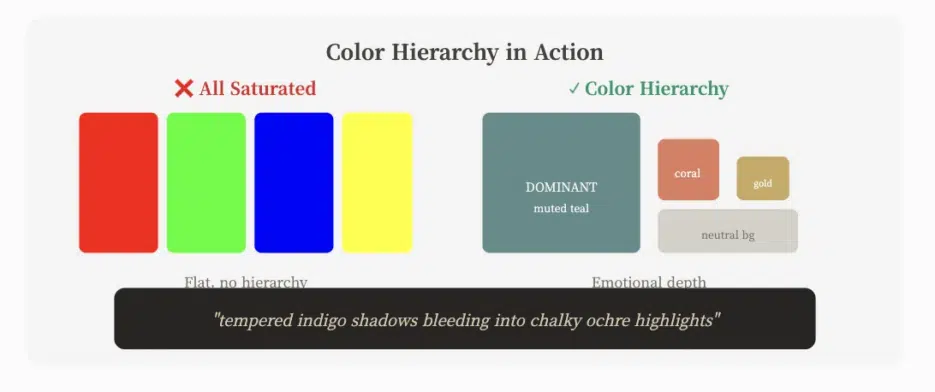
In fine art, color doesn't exist in isolation — it lives and breathes through contrast and balance. Vermeer's Milkmaid glows because the yellow apron sits next to quiet blues.
When you tell AI image models to create something "vibrant" or "bold," they often push all hues toward saturation, flattening emotional nuance.
Express through color relationships, not isolated colors:
"Dominant muted teal, accents of coral and antique gold, with a neutralized background."
Add modifiers that evoke real materials:
- matte
- pigment-like
- oxidized
- velvety
- washed with afternoon light
"tempered indigo shadows bleeding into chalky ochre highlights"
The goal is not color abundance, but harmony through limitation.
🌊 Thinking in Rhythm of Form
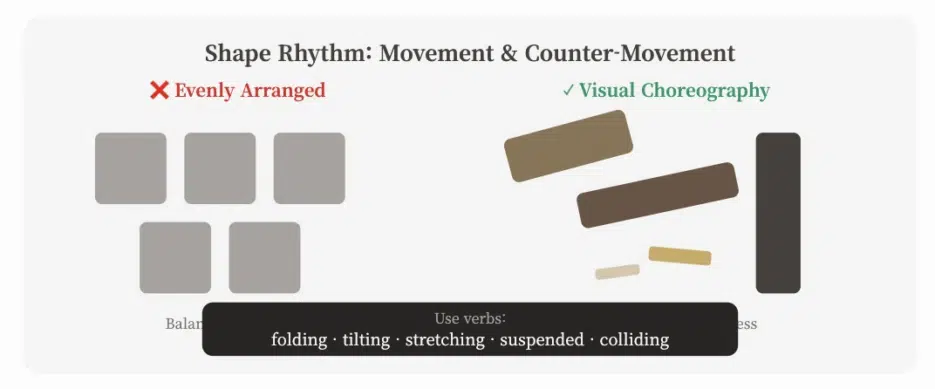
Every composition has a pulse. From Degas to Diebenkorn, painters understood that forms must move across the surface — curving, colliding, settling.
Left to its own devices, AI arranges forms too evenly. The result is balanced but lifeless.
Introduce movement and counter-movement in your prompts:
"Loose rhythm of sweeping diagonals interrupted by a calm vertical anchor."
"Massive quiet form offset by fine linear agitation."
Use verbs:
- folding
- tilting
- stretching
- suspended
- colliding
A sense of rhythm transforms flat design into visual poetry.
✨ Managing Texture and Edge Hierarchy
Edges are where emotion hides. The soft blur of Turner's skies and the sharp gleam in Sargent's brushwork tell viewers where to look and how to feel.
Specify variation to guide the model:
"Soft diffusion in secondary planes, crisp only at focal geometry."
"Surface shows layered pigment and brushed texture."
"Edges breathe and dissolve toward the periphery."
Expressions to avoid:
"sharp detail everywhere" — instead, instruct why clarity matters:
"Only the glass rim catches precise highlights; surrounding tones remain subdued."
Balance between focus and atmosphere gives AI images painterly discipline.
🖌️ Specifying Medium Simulation
Every medium speaks its own language:
- Watercolor — transparency and accident
- Oil — slow revision and depth
- Gouache — opacity and bleeding
- Risograph — matte layers
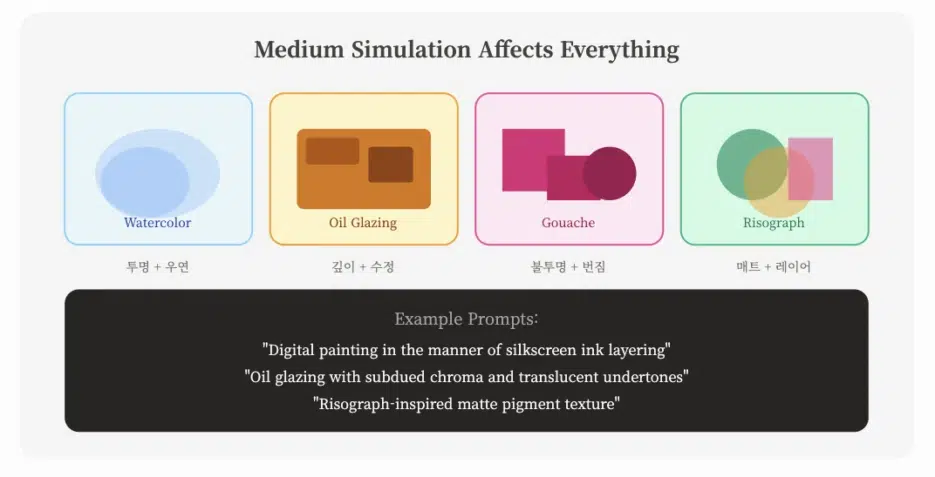
Medium Prompt Examples:
| Medium | Prompt |
|---|---|
| Silkscreen | "Digital painting in the manner of silkscreen ink layering" |
| Gouache | "Gouache-like opacity with controlled bleeding" |
| Oil Glazing | "Oil glazing with subdued chroma and translucent undertones" |
Tuning Light as Mood
Light is not mere illumination. It is time, temperature, and emotion.
Use atmospheric cues instead of "well lit":
| Common Expression | → | Atmospheric Expression |
|---|---|---|
| "well lit" | → | "Dappled studio light over raw canvas" |
| "bright" | → | "Late-afternoon warmth filtered through dust" |
| "soft lighting" | → | "Soft overcast reflection on pale concrete" |
| "cool tones" | → | "Muted fluorescent haze with cyan undertones" |
The difference between "golden glow" and "winter daylight slanting through a north window" is the difference between decoration and narrative.
🔄 Iterating Like a Painter
Painters build images in stages — sketching, layering, glazing, balancing.
Replace the "generate and judge" mindset with a process of gradual refinement.
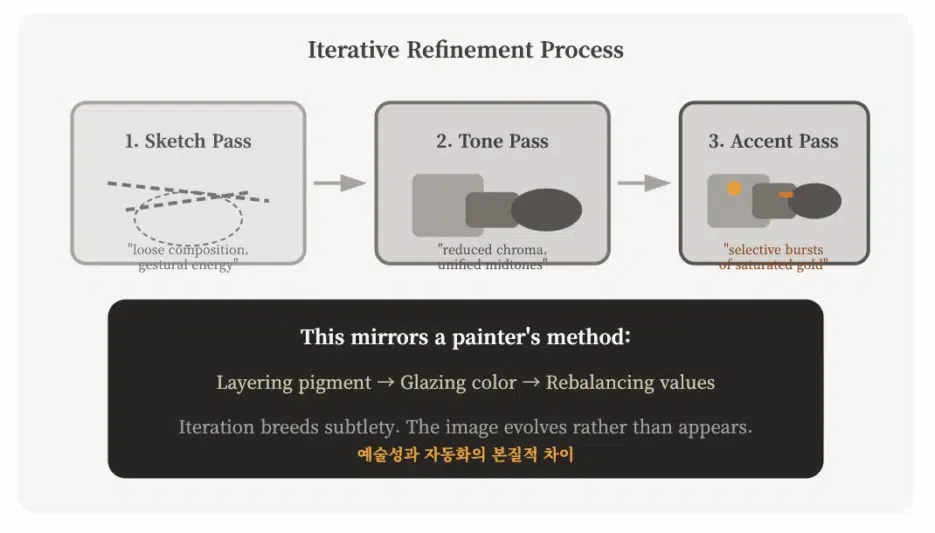
Practical Loop:
| Stage | Goal | Prompt Example |
|---|---|---|
| 1. Sketch Pass | Start broad | "loose composition, muted palette, gestural energy" |
| 2. Tone Pass | Refine mood | "reduced chroma, unified midtone structure, restrained highlights" |
| 3. Accent Pass | Reintroduce vibrancy | "selective bursts of saturated gold or warm light on focal edges" |
Iteration breeds subtlety. Images don't appear — they evolve — the essential difference between artistry and automation.
🎭 Introducing Accidental Harmony
Perfection is sterile. The human touch lives in near-misses.
Add constructive irregularity:
- "Slightly misaligned geometry"
- "Uneven paint edge with visible drag"


